After returning home from Kona, Hawaii, on Saturday, July 8th my wife and I headed to the area where we are going to set up in preparation for the total solar eclipse on August 21, 2017.
Since it is on private property I will not divulge the actual location except to say that it is north of the tiny town of Mitchell, Oregon (population 125).


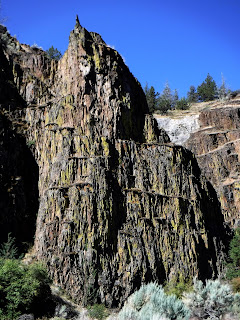
We were not prepared for the rugged beauty of the road that led to it! Wonderful!


Arriving there within minutes of the hour that the total eclipse will occur (about 10:21 am), our partner in this project greeted us and I set up the CATE equipment to prepare for an "on location, close to the actual time" imaging test.

I fully expected to complete my test within an hour but that was not to be. I just could not get polar alignment, even though I was quite sure I was near it. After nearly 2 hours of frustration, I gave up, took a few images and packed up the equipment.
My problem: The turf was soft and though I had initially leveled the tripod, when I added the counter-weight, the heavy telescope, and all the needed equipment... the leg points of the tripod were steadily but slowly sinking into the ground! AAAARRRGGH !
The solution for future reference: bring along some 12"x12"x 2" concrete stepping blocks to put under the tripod legs which will spread out the weight and prevent that "sinking feeling"!
On our return we encountered some old cars on a tour in the area! Fun!


Stopping in for late lunch in Mitchell we had some great burgers at the "Little Pine Cafe."
 Great burgers... and even my wife said so ! ...not to mention the fries... I loved'em ! The staff was helpful and willing to talk so we pushed the conversation to the fact that Mitchell is being touted as a "great place to view the eclipse from!" They were like "Great... we moved to Mitchell to get away from the crowds! LOL!"
There we found this informational card about the total eclipse (Mitchell is very near the center of the path of the shadow). Give it a read!


It is uncertain that this cafe will be open the day of the eclipse as some are saying that upwards of 50,000 may try to use Mitchell as their viewing point. This cafe, not to mention to whole town, can barely handle a couple of hundred people (insufficient parking, toilets, groceries, etc). Good luck if you try coming here!
Hunger satisfied, we headed next door to the Wheeler County Trading Company store.

They had eclipse t-shirts for sale... we had to get ours before the selfish people got theirs! LOL !


The high school football field was going to be my initial site for the CATE project but I was told that helicopter special services (sheriff, air life, military, etc.) had commandeered it. But it turns out that the high school is renting space on that football field... for a price... and a refundable deposit fee... can you say: $7,000 deposit? No that is NOT a typo! Don't think there will be many takers...
Having had a good laugh on that we were ready for some iced mochas. Having spied this one and only espresso booth ( Route 26 Espresso )just west of Mitchell we had to stop in.

Wide awake and cooled off (it was well into the 90's now) we headed home to La Pine...
...but not before stopping in at the Painted Hills unit of the John Day Fossil National Monument parks.

I checked with the the park rangers and found out that I still could not stay overnight there due to park regulations. Just as well, 50,000 people are likely to descend on this location as it is smack-dab on the center line of the eclipse... this little, itty bitty day-time only park with a small two lane road leading to it!
If you ever get a chance, take the time and see this little gem in the high desert of Oregon... just not on eclipse weekend!
Here's a sample!

Ok, here's the thing: The skies were clear and the Sun directly behind me in this shot which will mean that the lighting is "flat". My plan: Image the total solar eclipse from my private location and photoshop the blue sky out of it. Then replace the sky with the dark sky with the Sun in totality from my location and put it it over the Painted Hills photo (since few will be able to do that in reality I feel justified in giving it a try!)

The national park system is advertising their places in the path of the eclipse with these awesome posters:


They even have a card stock poster that has safety solar glasses on top!

Upon arrival back at home, I immediately ran a test CATE imaging session with three concrete stepping stones I had already under each leg of the tripod on grass:

...and BINGO! My "sinking" (aka stinking) problem was solved! I notified my fellow CATE observers via Facebook of this "discovery" and it was met with a number of "Likes" and "Thanks for the idea!"
Since it is on private property I will not divulge the actual location except to say that it is north of the tiny town of Mitchell, Oregon (population 125).


We were not prepared for the rugged beauty of the road that led to it! Wonderful!


Arriving there within minutes of the hour that the total eclipse will occur (about 10:21 am), our partner in this project greeted us and I set up the CATE equipment to prepare for an "on location, close to the actual time" imaging test.

I fully expected to complete my test within an hour but that was not to be. I just could not get polar alignment, even though I was quite sure I was near it. After nearly 2 hours of frustration, I gave up, took a few images and packed up the equipment.
My problem: The turf was soft and though I had initially leveled the tripod, when I added the counter-weight, the heavy telescope, and all the needed equipment... the leg points of the tripod were steadily but slowly sinking into the ground! AAAARRRGGH !
The solution for future reference: bring along some 12"x12"x 2" concrete stepping blocks to put under the tripod legs which will spread out the weight and prevent that "sinking feeling"!
On our return we encountered some old cars on a tour in the area! Fun!


Stopping in for late lunch in Mitchell we had some great burgers at the "Little Pine Cafe."

There we found this informational card about the total eclipse (Mitchell is very near the center of the path of the shadow). Give it a read!


It is uncertain that this cafe will be open the day of the eclipse as some are saying that upwards of 50,000 may try to use Mitchell as their viewing point. This cafe, not to mention to whole town, can barely handle a couple of hundred people (insufficient parking, toilets, groceries, etc). Good luck if you try coming here!
Hunger satisfied, we headed next door to the Wheeler County Trading Company store.

They had eclipse t-shirts for sale... we had to get ours before the selfish people got theirs! LOL !


Having had a good laugh on that we were ready for some iced mochas. Having spied this one and only espresso booth ( Route 26 Espresso )just west of Mitchell we had to stop in.

Wide awake and cooled off (it was well into the 90's now) we headed home to La Pine...
...but not before stopping in at the Painted Hills unit of the John Day Fossil National Monument parks.

I checked with the the park rangers and found out that I still could not stay overnight there due to park regulations. Just as well, 50,000 people are likely to descend on this location as it is smack-dab on the center line of the eclipse... this little, itty bitty day-time only park with a small two lane road leading to it!
If you ever get a chance, take the time and see this little gem in the high desert of Oregon... just not on eclipse weekend!
Here's a sample!

Ok, here's the thing: The skies were clear and the Sun directly behind me in this shot which will mean that the lighting is "flat". My plan: Image the total solar eclipse from my private location and photoshop the blue sky out of it. Then replace the sky with the dark sky with the Sun in totality from my location and put it it over the Painted Hills photo (since few will be able to do that in reality I feel justified in giving it a try!)

The national park system is advertising their places in the path of the eclipse with these awesome posters:


They even have a card stock poster that has safety solar glasses on top!

Upon arrival back at home, I immediately ran a test CATE imaging session with three concrete stepping stones I had already under each leg of the tripod on grass:

...and BINGO! My "sinking" (aka stinking) problem was solved! I notified my fellow CATE observers via Facebook of this "discovery" and it was met with a number of "Likes" and "Thanks for the idea!"


