Saturday, April 9, 2016

April 8, 2016 Another clear night and M65 and M66

After getting home from helping at Celebrate Recovery I expected the skies to be mucky. But they were relatively clear! Three nights in a row! Woohoo! So it was back to the obs for a short session.
Tonights prey: Two galaxies at the base of the constellation Leo, the Lion.

Tonight I used my Canon XTI on the NexStar 8iSE attached to the LXD-75 GEM mount. This would be the first time I have used this camera for astrophotography. I have read that its pixels are larger and though it does not have as high an ISO than newer cameras (like my Canon T3i) those larger pixels can capture dimmer objects a little better, though at a loss of image size. Again, this evening I attached the Celestron focal reducer (f/6.3) to the scope and the camera to it.

Working with the Canon XTI is more difficult as it does not have a "live" feature to it that allows you to see on the display screen what the camera sees in real time. So I have to do a number of focus and centering tests before I was able to start imaging (a time consumer to a degree.)

Finally, focused properly (using the star Regulus and a Bahtinov mask) I set about to find and center on M65 and M66.

M65 (the galaxy in the upper right) is an intermediate spiral galaxy about 35 million light-years away in the constellation Leo. It was discovered by Charles Messier in 1780. M65, M66, and NGC 3628 comprise the famous Leo Triplet, a small group of galaxies.
M65 (top) and M66 (bottom)
Given the dimness of these galaxies the total exposure time was 10 min 45 sec (48 subs at 15 sec each, ISO 1600). I was hoping for a little more detail, but that will come with more total time.

Well, it was a long day (two trips to the dump) and not feeling all that good, I shut-er-down and hit the sack.

April 7, 2016 Another CLEAR night in a row photographing M3, M5, M51, M63, M101

Can you believe it, TWO nights in a row!

Since the new setup with the marriage of the NexStar 8iSE and the Meade LXD-75 GEM worked out so well the previous night, I decided to use this evening to attempt some astrophotography with my Canon t3i. My setup up was the scope with a Celestron f/6.3 reducer, which would give a wider field of view than at prime focus and also shorted the exposure times. The down side is that what I capture would be half the size compared to photographing at prime focus. But for this evening I wasn't concerned about that. Instead I just wanted to see how this setup worked photographically.

My first target was Messier 5 or M5 (also designated NGC 5904) is a globular cluster in the constellation Serpens. Under extremely good conditions, just visible to the naked eye as a faint "star" near the star 5 Serpentis. Binoculars or small telescopes will identify the object as non-stellar while larger telescopes will show some individual stars, of which the brightest are of apparent magnitude 12.2. M5 was discovered by the German astronomer Gottfried Kirch in 1702 when he was observing a comet. Charles Messier also noted it in 1764, but thought it a nebula without any stars associated with it. William Herschel was the first to resolve individual stars in the cluster in 1791, counting roughly 200.
M5
This was only a 1 minute 10 second exposure made up of 7 - 10 sec exposures at ISO 3200 that were stacked in software known as DeepSkyStacker Live. You can see the various colors of different stars in this image, blues and oranges. More detail would have resulted from more exposures, so I will revisit M5 in the future photographically.

With that success I moved on to M3. Messier 3 (also known as M3 or NGC 5272) is a globular cluster of stars in the northern constellation of Canes Venatici. It was discovered by Charles Messier on May 3, 1764,[8] and resolved into stars by William Herschel around 1784. Many amateur astronomers consider it one of the finest northern globular clusters. This cluster is one of the largest and brightest, and is made up of around 500,000 stars. It is estimated to be 8 billion years old. It is located at a distance of about 33,900 light-years away from Earth.
M3
I was surprised by how bright M3 was compared to M5! This is a 1 minute 40 sec exposure created from 10 - 10 sec subs at ISO 3200. Again, notice the various colors of the stars in this cluster. Quite a jewel box !

Well, that was fun! But the evening (55 degrees F)  had just begun! Sure, star clusters are easy to image but dimmer objects like distant galaxies were on my mind... so...on to GALAXIES!

First up, galaxy-wise, was M51. M51 (aka "The Whirlpood Galaxy") has always been one of my favorite galaxies to view in a big telescope. It is one of the best known galaxies in the sky. The galaxy and its companion, NGC 5195, are easily observed by amateur astronomers, and the two galaxies may even be seen with binoculars under clear and dark skies! The Whirlpool Galaxy is also a popular target for professional astronomers, who study it to further understand galaxy structure (particularly structure associated with the spiral arms) and galaxy interactions.
M51 - The Whirlpool Galaxy
This galaxy is found inside the arc that makes up the Big Dipper's handle (Ursa Major). This is the result of 2 minutes of exposure (about 12 - 10 sec subs at ISO 6400). Can't wait to give this more attention in the future! But there are more galaxies to image!

Next up was M63. This would be a difficult one to image as it was much dimmer. Otherwise known as the Sunflower Galaxy, Messier 63 is a spiral galaxy in the constellation Canes Venatici (south of and near the Big Dipper) consisting of a central disc surrounded by many short spiral arm segments.
M63 - The Sunflower Galaxy
It was also difficult to find, as my goto alignment on the mount wasn't precise that night. Having found it, this is the result of 2 minutes 30 seconds of exposure (about 15 - 10 sec subs at ISO 6400)
Just another galaxy that needs more imaging !

Not satisfied with the crop of clusters and galaxies captured so far (and getting a little tired as it was approaching 11 pm), I thought I would try one more.

So I moved on to M101. Also known as The Pinwheel Galaxy, M101 is a face-on spiral galaxy distanced 21 million light-years away in the constellation Ursa Major (near the star farthest from the end of the handle of the Big Dipper). M101  it is roughly equal the size of our own galaxy, the Milky Way Galaxy.
M101 - The Pinwheel Galaxy
Though much larger in the view of view than M51, it is much dimmer, and so I had to increase the number of exposures to make this image (total time: 3 minutes 40 secs, ISO 6400, 22 - 10 sec subs)

Well, a very exciting evening it was. The temp was just starting to drop, I had also seen a brilliant meteor cross the eastern sky, south to north, and was needing some sleep. So I shut-er-down and hit the sack!


April 6, 2016 Getting the GEM setup with the NexStar 8iSE scope

Warm weather moved into the interior of Oregon and so I headed out to the obs to do some aligning of my new setup.
I demounted the optical telescope assembly of the Celestron NexStar 8iSE (OTA, in other words, the telescope itself) from the alt/az mount it came with and put a dovetail bar on it. Then I was able to attach it to my LXD75 German equatorial mount (GEM).

Since the tripod legs of the GEM needed to be isolated from the obs floor, I cut three 12"x12" holes in the floor, inserted the needed concrete pads, and placed the GEM on them. Now if I breathe the image in the scope doesn't jump around !
But as far as polar alignment was concerned I just guessed where to put the mount on the concrete pads, leveled the mount, and figured I would have to take a good portion of the evening of April 6th just trying to get it aligned.
But to my absolute surprise, when I turned the mount on, and pointed the scope at Jupiter it stayed in the field of view at low power. So I tried higher power. It stayed! So I tried it at even higher power with my Mallincam Micro-EX astrovideo camera (which has a very narrow field of view when using it at the prime focus of the telescope... and it pretty much stayed in the field of view even then!
Talk about getting lucky !

I will post the results when I update this page in a couple of days.

Jupiter wasn't really clear as the winds aloft were blurring detail, yet I was able in those brief moments of stillness to see the shadow of Jupiter's moon, Io, as it slowly crossed the planet's disk.
That was a first for me and I shared it on Night Skies Network http://www.nightskiesnetwork.ca/ with a few of my online friends from New Zealand, Australia, and others around the world. 

Friday, March 18, 2016

It was a windy night...

... but I got out into the observatory to check out my Celestron NexStar 8iSE on the Moon.
Here are some images captured through it. I ended my session within the hour as the winds were swirling in the observatory and moving the scope too much for photography and the winds aloof were blurring the view of the Moon.


Thursday, March 17, 2016

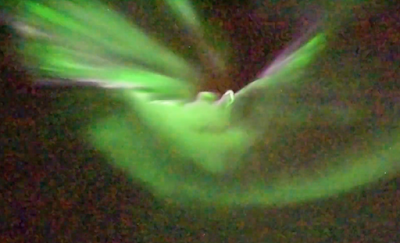
Ever wonder what Northern Lights look like in REAL time (not time-lapse)?

Alan Dyer braved the cold air of Churchill, Manitoba, to grab real-time video of an auroral display that approximates very closely what you can see with your unaided eye. The low-light views of the night sky available with modern digital cameras are truly amazing. And it is just a coincidence that there is a lot of green in this video (it's St. Patricks Day, you know!)

https://vimeo.com/155760010

Tuesday, March 15, 2016

Awesome shot of the Total Solar Eclipse I saw on Facebook

Just saw this shot on Facebook by Shigemi Numazawa (https://www.facebook.com/numazawa7) of the corona during the total eclipse in Indonesia. Great wider view!


This image is a combined shot (HDR) at various exposures to bring out the best in the eclipse.
If you look carefully enough you can actually see detail in the Moon itself ! 

Way to go Shigemi!

Wednesday, March 9, 2016